
Essential CEU Institute
The Challenge
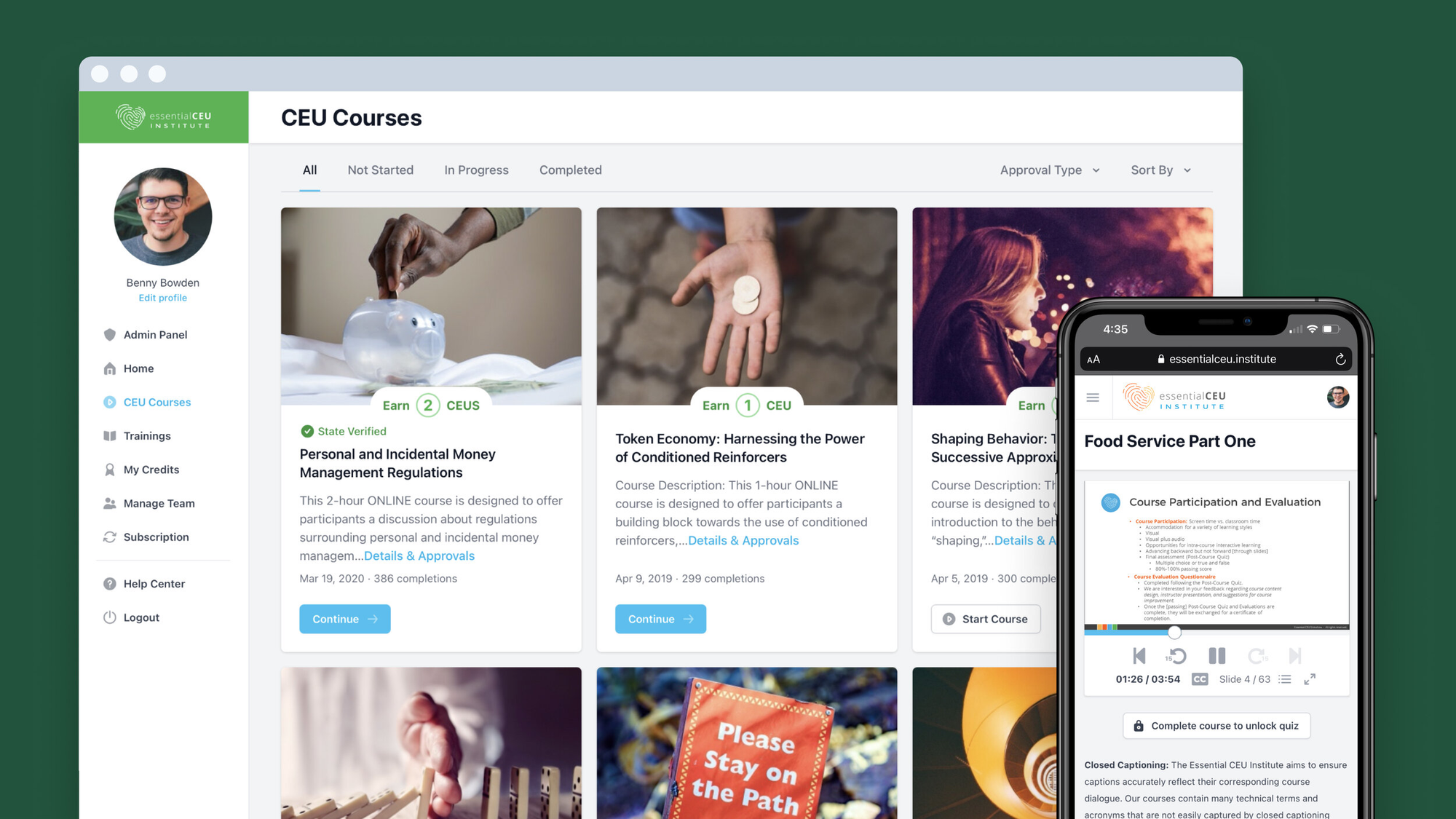
Essential CEU Institute came to us with a working SaaS platform, but they knew it could be more. For years, they'd been serving healthcare professionals in California with state-approved continuing education courses. The core service worked. People subscribed, took courses, earned certificates, and maintained their licenses.
But the platform had evolved organically, adding features as needs arose without a cohesive strategy. The result was a functional but fractured experience. Users struggled to navigate between different types of content. The information architecture had grown tangled. And most critically, Essential CEU was missing an opportunity to increase subscriber value and retain long term customers.
As product designer for this project at Moonbase Labs, I worked with a small team to transform Essential CEU from a course library into a unified training management system.
Uncovering the Real Opportunity
Our initial objective was straightforward: improve the user experience, clean up the interface, make it easier to find and complete courses. Standard optimization work.
But as we started talking to users — both individual healthcare professionals and team administrators at healthcare organizations — a different picture emerged.
The pain point wasn't just about consuming Essential CEU's courses. It was about managing all training requirements in one place. Healthcare professionals attend conferences, complete external certifications, and participate in employer training programs — all of which contribute to their job certifications and license renewals. They needed to track everything in one place, but no single tool gave them that comprehensive view.
Individual subscribers told us they were maintaining separate spreadsheets. Team administrators were juggling multiple systems. Everyone was doing manual work that should have been automated.
Essential CEU had an opportunity to become the single source of truth for healthcare training, going from a conventional course provider to a complete training management platform.
The strategic insight: Let users document external training alongside Essential CEU courses. Give them a unified transcript. Make the platform valuable even when they're not actively taking courses. Create a reason to maintain their subscription year-round.
The business case was compelling. Higher retention meant more predictable revenue. Increased subscriber lifetime value meant better unit economics. And the feature would differentiate Essential CEU in a crowded continuing education market.
Aligning Stakeholders Without Slowing Down
When planning features with non-technical stakeholders, communication breakdown is the biggest risk. For the external course entry feature, I needed to get everyone aligned quickly without getting bogged down in lengthy requirements documents.
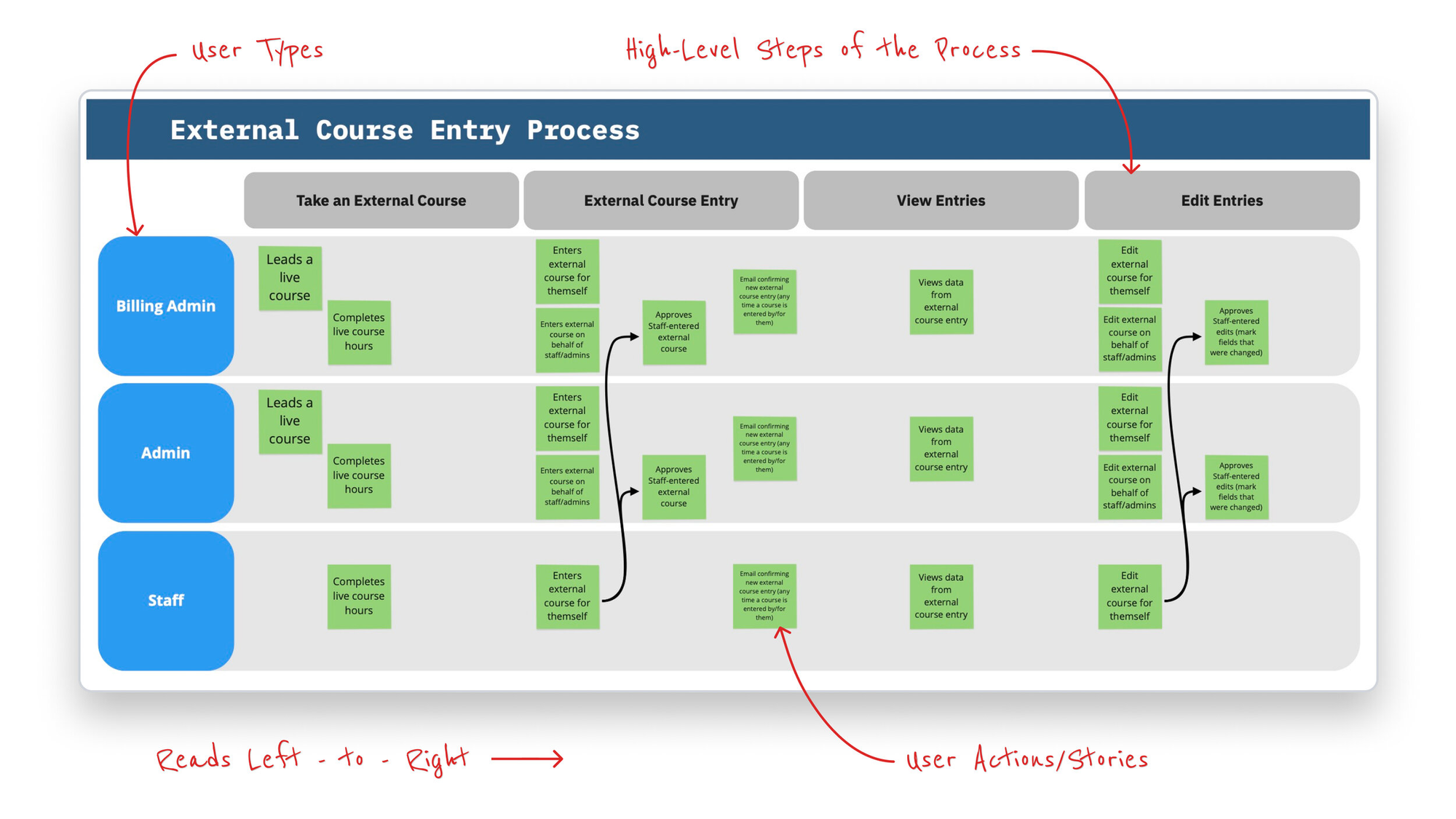
I created a process diagram in Miro that became our shared language. The diagram included three critical elements:
User Types — Who interacts with the system at each stage (Billing Admin, Admin, Staff)
High-Level Steps — The major phases of the process (Take an External Course, External Course Entry, View Entries, Edit Entries)
User Actions — Specific tasks and decision points within each phase
This single artifact helped us:
- Identify edge cases early ("What happens if someone needs to edit an entry after submission?")
- Align on approval workflows ("Do admins get approval emails for everyone, or just their own entries?")
- Confirm scope before writing code ("Are we building automatic reminders for expiring certifications? Not in V1.")
The diagram technique worked because it gave stakeholders something concrete to react to. Rather than abstract discussions about "how the system should work," we could point to boxes and arrows and say, "This is what happens when a staff member submits a course entry."
We moved fast, gathered the details we needed, and confirmed everything with stakeholders before developers wrote a line of code.
Translating for Software
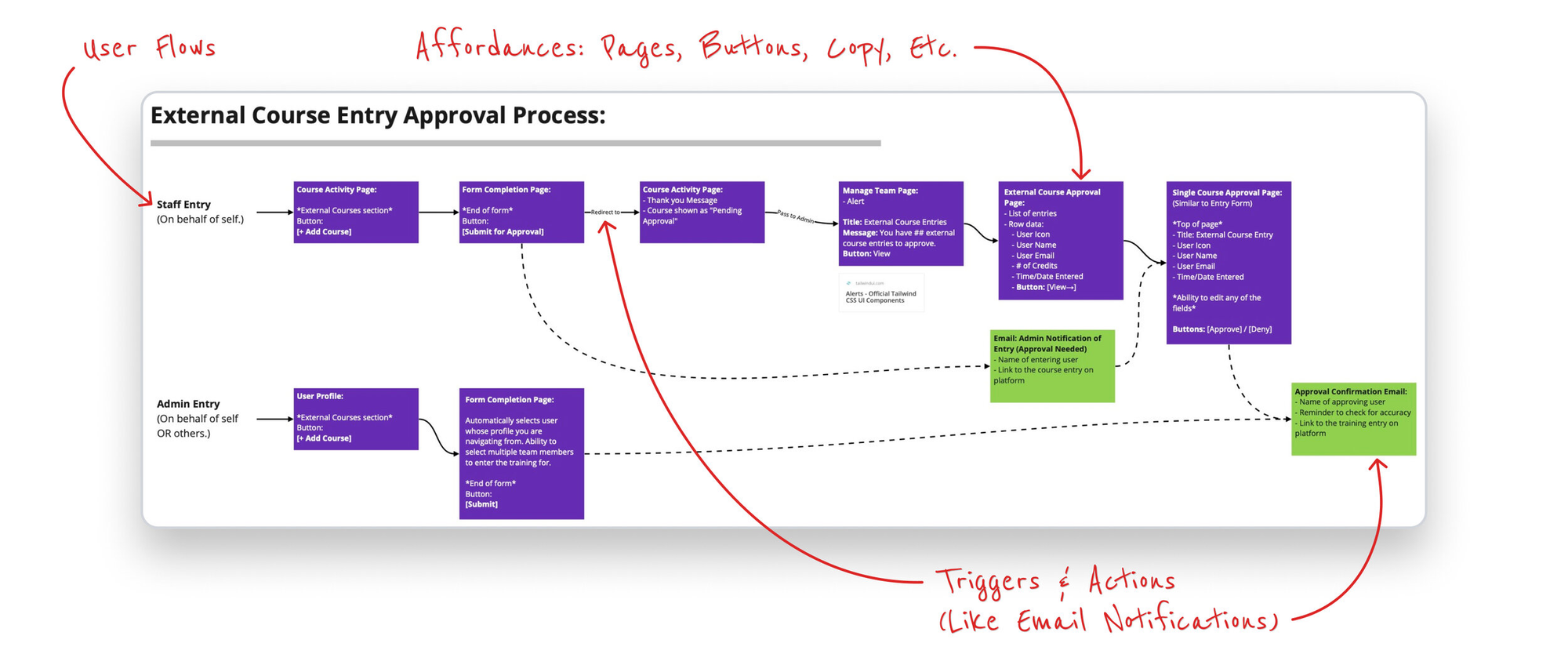
A simple process diagram isn’t enough to prepare a feature for implementation by engineers. To communicate the process and outline design elements for developers, I created in-depth user flows that showed:
- Affordances — What UI elements appear at each step (buttons, form fields, notifications)
- Triggers and Actions — What causes state changes (clicking "Submit" sends an email notification to the admin)
- Decision Points — Branching logic ("If approved → show in transcript. If rejected → notify user with reason.")
Critically, I held off on high-fidelity mockups at this stage. The flows included layout sketches and component notes, but I didn't spend time perfecting visual design.
Minimum Viable Fidelity
The developers on our team were comfortable building from wireframes and written specifications. Spending days in Figma polishing pixel-perfect screens would have been wasted effort.
This is what I call Minimum Viable Fidelity: deliver exactly the level of design documentation your team needs to build successfully. No more, no less.
For this feature, wireframes with annotations were sufficient. I could spend my time on the hard problems and then help developers refine their output, instead of moving pixels around in a silo.
Redesigning User Profiles for Clarity
Adding external course tracking created a new problem: user profiles were about to get cluttered. Previously, profiles showed one list 0f courses taken through Essential CEU. Now they needed to display:
- Essential CEU Courses (from the platform)
- Essential Trainings (employer-specific content)
- External Courses (certifications from anywhere)
Plus, team administrators needed visibility into their staff's progress across all three categories.
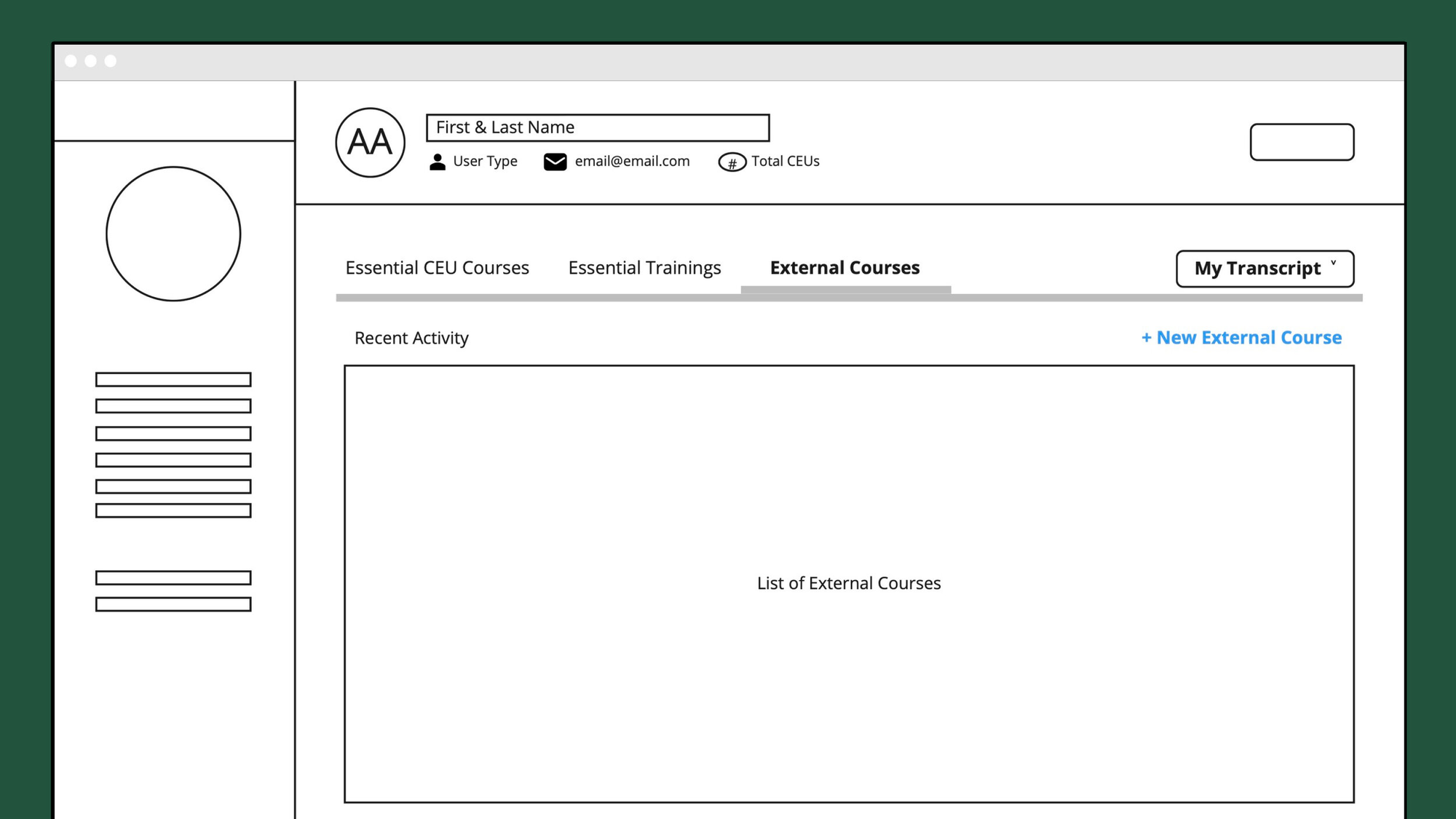
I redesigned the profile interface with tabbed navigation that separated each content type while maintaining a unified transcript view. Each tab showed relevant filters, sort options, and action buttons specific to that context.
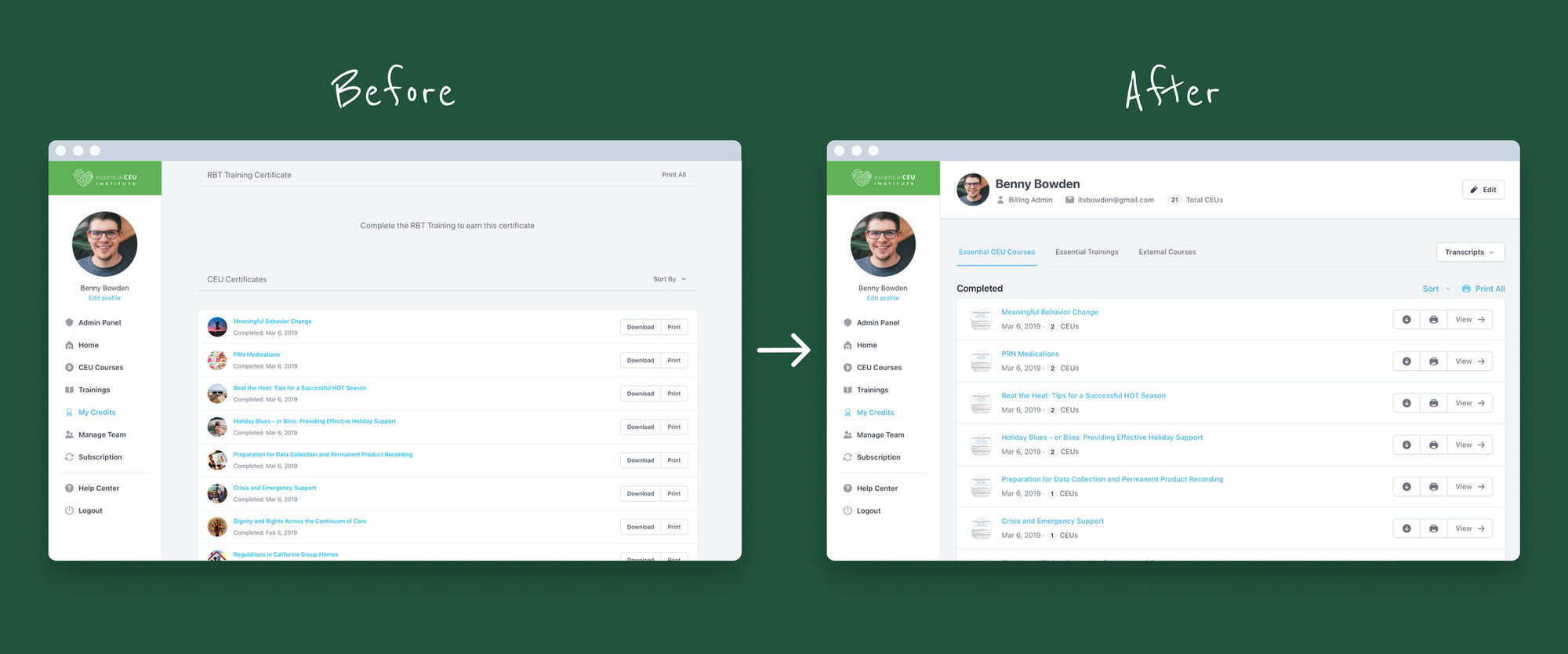
Before: A single, growing list of courses with no clear organization. Users scrolled endlessly looking for specific completions. The profile felt like a receipt drawer with everything piled together chronologically.
After: Clean separation of course types with consistent interaction patterns. A "My Transcript" view that compiled everything for license renewal. Quick access to add new external courses. Visual indicators for completion status, expiration dates, and credit hours earned.
The redesign solved the immediate problem (organizing the new feature) while improving the existing experience (making Essential CEU courses easier to navigate too).
The Results
The external course entry feature launched successfully and delivered measurable business impact:
✦ 29,000+ total course certificates issued to 3,100+ users over four years
✦ 14,000+ certificates issued in 2020 alone — nearly double the previous year's volume, demonstrating accelerated growth
✦ Increased user retention — subscribers maintaining memberships longer to use the platform as their unified training hub
✦ Expanded value proposition — Essential CEU evolved from "a place to get CE credits" to "the system for managing all professional development"
✦ Higher engagement — users returning to the platform between Essential CEU courses to log external training, keeping the product top-of-mind year-round
The platform became sticky in the way SaaS products should be. Users integrated it into their workflow, stored valuable data there, and would face friction switching to a competitor. That stickiness translated directly to revenue retention.
Beyond the numbers, qualitative feedback confirmed we'd solved a real problem. Healthcare professionals told us they finally had one place to track everything. Team administrators could see compliance status at a glance. The feature worked.
More importantly, this project demonstrated how strategic product thinking, efficient design processes, and strong cross-functional collaboration can transform a single feature addition into a platform-wide value enhancement.
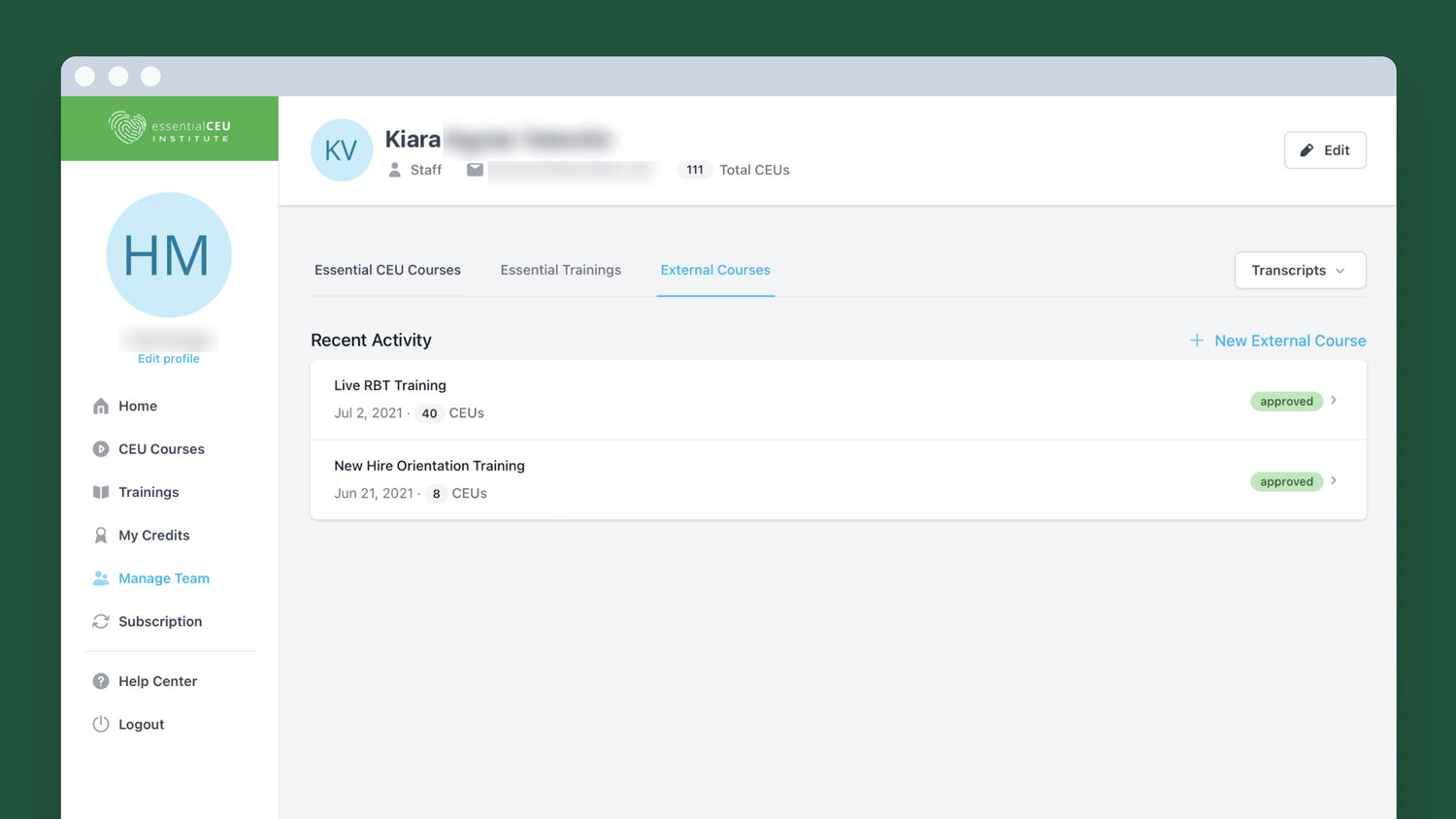
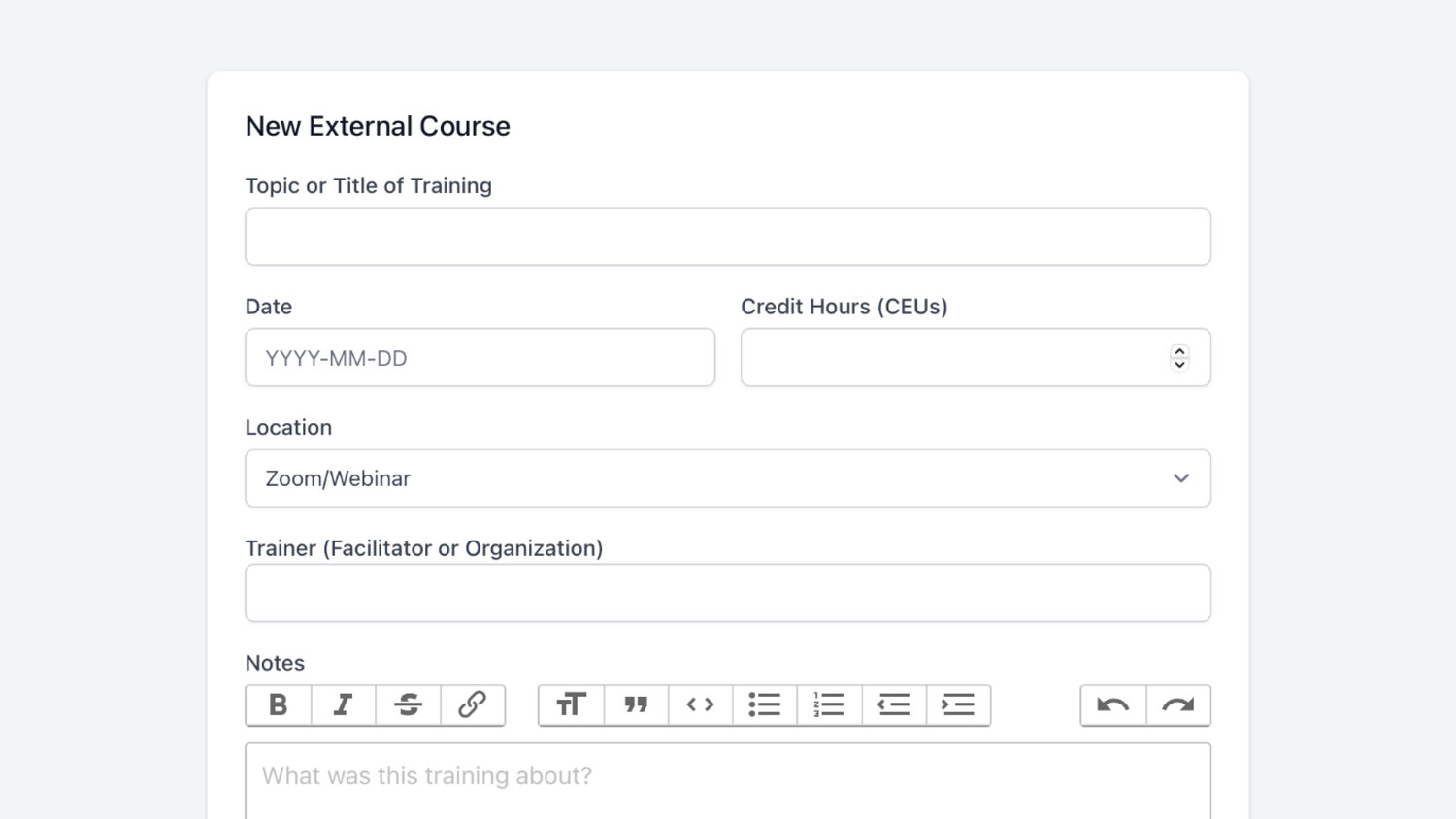
Left: External courses page on user profile, Right: External course entry form
What I Learned
Start with the user's actual job, not just your product. Essential CEU initially thought in terms of "improving our course library." But the users' real job was to "maintain my professional license," which involved training from many sources. By zooming out, we found a much more valuable solution.
Process diagrams are worth their weight in gold. Creating that Miro board took a few hours. It saved us weeks of miscommunication and rework. When stakeholders can see the flow visually, they spot problems and edge cases immediately. No amount of written documentation has the same effect.
Minimum Viable Fidelity accelerates delivery without sacrificing quality. High-fidelity mockups are beautiful, but they're not always necessary. If your developers are comfortable working from wireframes and your system is well-defined, you can move faster by designing at lower fidelity. Save the polish for the most impactful customer-facing interfaces.
Small teams can move incredibly fast with the right constraints. Three people (two developers, one designer) shipped a full platform evolution in a tight timeline. We succeeded because we made deliberate choices about what to optimize for: clear requirements, lean documentation, focused scope, and trust between team members.
"Redesigns" have cascading benefits. Solving the user profile's "too many content types" problem with tabbed navigation accommodated the new feature, but it also improved the existing experience. Good design solutions often make new things possible while making the old things better.
Let's Design Your Product
Looking for a product design partner on your next project? I take on select freelance work and welcome new collaborations.
Project Details
Team: 2 developers, 1 designer (me)
Company: Moonbase Labs (agency)
Client: Essential CEU Institute
Live project: essentialceu.institute
Responsibilities:
- User research and discovery interviews
- Product strategy and feature prioritization
- Process mapping and stakeholder alignment workshops
- User flow creation and interaction design
- Information architecture redesign for user profiles
- Wireframing and UI design
- Developer collaboration and technical specification documentation
- Quality assurance and design review throughout implementation